
A stiff knee is a very common problem that can happen to anyone.
For some, it may develop after physical activity or overuse, while for others, especially older adults, it can be linked to natural wear and tear in the knee joint.
When your knee feels stiff, you may find it hard to bend or straighten it fully. This limited movement is often accompanied by discomfort or pain, which can make everyday activities such as walking, standing, or climbing stairs difficult and frustrating.
While occasional stiffness might be a minor inconvenience, persistent symptoms can signal an underlying issue requiring attention. Ignoring these symptoms may allow the condition to worsen over time.
In this post, we explain what a stiff knee really means, explore the possible causes and warning signs, and discuss treatments you can try at home as well as professional care options.
What is a Stiff Knee?
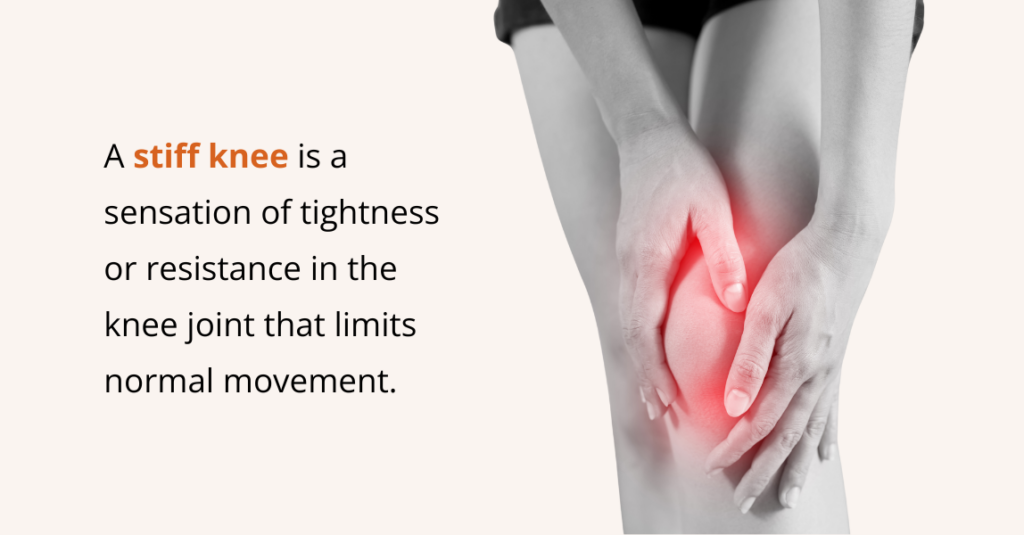
A stiff knee is a sensation of tightness or resistance in the knee joint that limits normal movement.
You may find it hard to fully straighten (extend) or bend (flex) your knee. This stiffness can be accompanied by pain, swelling, or a feeling of “locking.”
It’s not a diagnosis itself but rather a symptom of various conditions affecting the joint’s structures, including bones, cartilage, ligaments, tendons, or the joint lining.
For example, if a meniscus cartilage is torn or a ligament is stretched, you might feel the knee locking or catching and unable to straighten. Likewise, arthritis causes swelling of the joint surfaces, making movement feel painful and limited.
What are the Causes of a Stiff Knee?
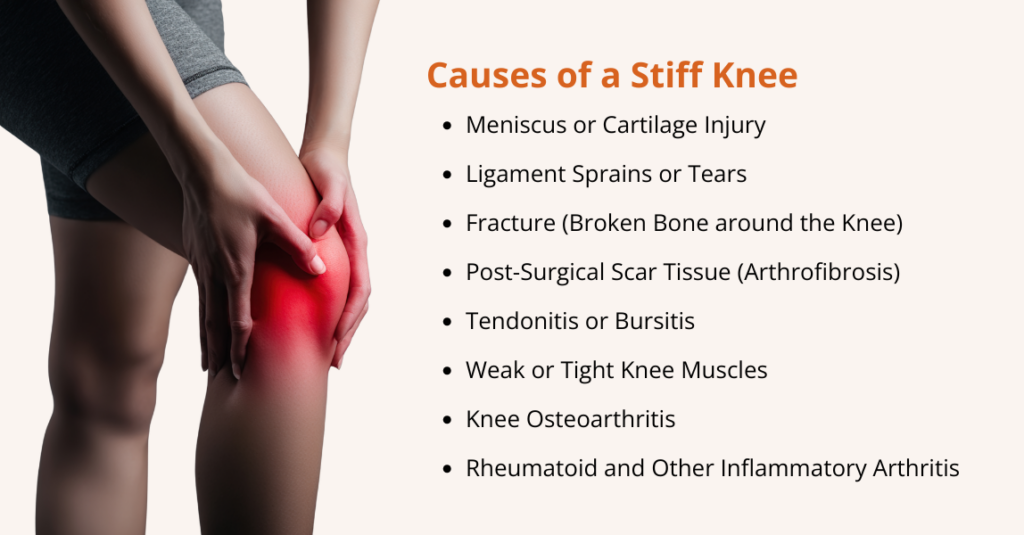
Knee stiffness can arise from a variety of causes, including injuries, wear and tear, inflammation, and infection. Potential causes of knee stifness include:
Meniscus or Cartilage Injury
The menisci are C-shaped cushions of cartilage between the thighbone and shinbone. A sudden twist or fall can tear a meniscus, or age-related wear can weaken it.
When the meniscus tears, the knee often locks or becomes stiff because the torn fragment blocks motion. Patients may hear or feel a pop when it tears, then notice:
- Pain and swelling around the knee
- Locking or catching, inability to fully straighten the knee
- Loss of motion and a feeling that the knee might give way
Even if you can still walk, the knee may feel stiff or stuck. Torn cartilage is a common cause of acute stiffness, and it often requires imaging or a doctor’s exam for diagnosis.
Ligament Sprains or Tears
Ligaments are strong bands that connect the knee bones. A sudden twist, impact, or hyperextension can sprain or tear a ligament.
This usually causes immediate pain and swelling, which in turn makes the knee stiff. You might also feel the knee is unstable or weak. Common signs include:
- Knee pain and swelling shortly after the injury
- Instability, like a sensation that the knee may buckle or give out
- Limited motion and difficulty bending or straightening the knee fully.
For example, an anterior cruciate ligament (ACL) tear often causes rapid swelling (hemarthrosis) and a sensation of the knee locking in place. Like a torn meniscus, a torn ligament usually causes stiffness until it heals or is repaired.
Fracture (Broken Bone around the Knee)
A bone fracture in or near the knee (such as a broken kneecap, tibia, or femur) makes the knee very stiff. The fracture causes severe pain, swelling, and, in many cases, a visible deformity, thereby preventing normal knee movement.
Symptoms of a knee-area fracture include:
- Severe pain, especially with any weight on the leg
- Swelling and bruising around the knee
- Tenderness and deformity (the knee may look “out of place” or bent)
Because a fracture is an emergency, it must be treated right away (often with immobilization or surgery). Without proper alignment, broken pieces will keep the knee locked and stiff.
Post-Surgical Scar Tissue (Arthrofibrosis)
Sometimes, after surgery (or a bad injury), the knee heals with too much scar tissue in the joint. This condition, called arthrofibrosis or “stiff knee syndrome,” literally glues down the joint.
Excess scar tissue makes bending or straightening the knee very difficult. People with arthrofibrosis typically have:
- Progressively worsening pain and stiffness after surgery
- Swelling and a feeling of heat in the knee
- Difficulty fully extending the knee (often the leg stays slightly bent)
Research shows that about 2–35% of patients develop arthrofibrosis after major knee operations like ACL reconstruction or joint replacement.
Tendonitis or Bursitis
Overuse or irritation of knee tendons and bursae can also cause stiffness. For example, patellar tendonitis (“jumper’s knee”) inflames the tendon below the kneecap.
Likewise, bursitis inflames a fluid-filled sac (bursa) in the knee (often in front of or inside the knee). Both lead to swelling and pain that limit motion. Typical features include:
- Patellar (knee) tendonitis: Pain and tenderness at the front of the knee, especially just below the kneecap.
- Knee bursitis: Painful swelling over a bony point of the knee. The area often feels warm, tender, and swollen, and knee movement may be painful or limited.
In both cases, inflammation makes the joint feel tight and usually worsens with activity (e.g, jumping or climbing stairs).
Weak or Tight Knee Muscles
The muscles around your knee, especially the quadriceps (front of the thigh) and hamstrings (back of the thigh), play a key role in supporting and stabilizing the joint.
If these muscles are weak, the knee can move less smoothly and may be more prone to injury. On the other hand, if the muscles are very tight, they can pull on the joint unevenly, limiting motion and making the knee feel stiff.
Research has shown that tight quadriceps muscles can increase stress on the knee joint and may contribute to the development of osteoarthritis over time.
Knee Osteoarthritis
Osteoarthritis (OA) is the most common reason for long-term knee stiffness. In OA, the cartilage cushioning the joint gradually wears away.
As the cartilage thins, bone rubs on bone, and small bony spurs (osteophytes) can grow. This leads to chronic pain, swelling, and stiffness. As a result, individuals often notice stiffness when rising from a seated position or upon waking.
Rheumatoid and Other Inflammatory Arthritis
Autoimmune arthritis (like rheumatoid arthritis, psoriatic arthritis, or lupus) attacks the knee’s lining (synovium) and causes chronic inflammation.
In rheumatoid arthritis (RA), for example, the immune system inflames the joint lining, leading to swelling, warmth, and pain. This inflammation causes the knee to become extremely stiff, particularly in the morning or after rest, resulting in:
- Swollen knee
- Warm joints
- Persistent stiffness
- Fluctuating pain
Other inflammatory diseases, such as gout or pseudogout (see below), similarly cause episodes of sudden pain and stiffness. Overall, any form of chronic arthritis means ongoing joint swelling that leads to limited motion and stiffness.
What are the Symptoms of a Stiff Knee?
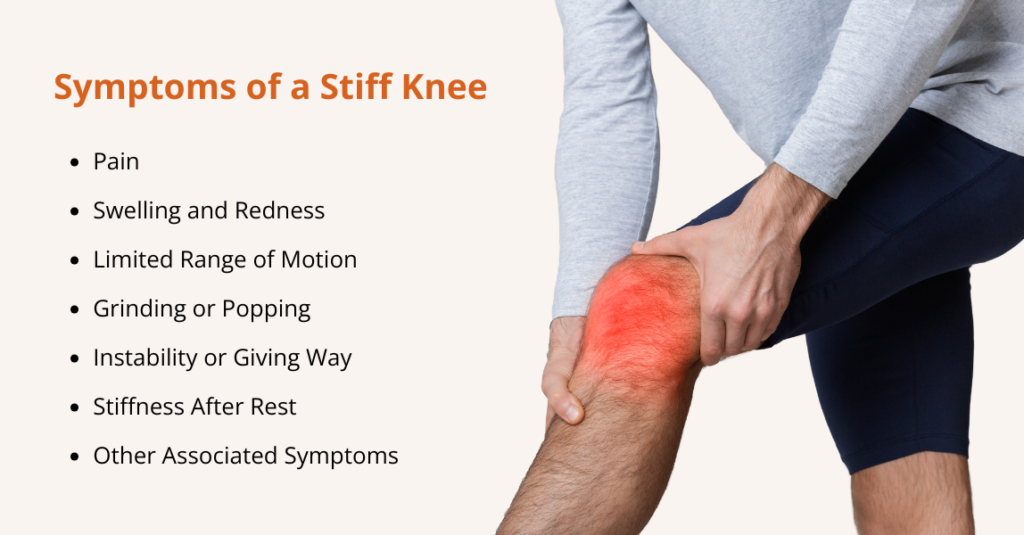
A stiff knee often comes with other symptoms. These may include:
- Pain: You may feel aching, burning or stabbing pain in the knee. Bel Marra Health notes that a stiff knee often brings sharp or aching pain, especially when moving.
- Swelling and Redness: Inflammation often causes the knee to swell. Warmth and redness can occur if there is active inflammation or infection.
- Limited Range of Motion: You might not be able to fully bend or straighten the knee. The joint may feel locked or catch at certain angles.
- Grinding or Popping: You may hear or feel noises in the knee, such as creaking, clicking or grinding sounds (called crepitus) when moving an arthritic knee.
- Instability or Giving Way: The knee may feel weak or buckle under weight. Ligament injuries or advanced arthritis can make the knee unstable.
- Stiffness After Rest: Knees with arthritis or inactivity may feel especially stiff after sitting or sleeping. It often eases with light movement
- Other Associated Symptoms: Other symptoms like fever, severe pain at rest, or knee deformity are less common but important red flags.
Importantly, a key point is that stiffness often comes with some pain or swelling, though the knee may not always be very painful.
Treatments for Stiff Knees
The most suitable treatment for knee stiffness depends on the cause and severity. Mild stiffness often improves with home care, while persistent or severe cases may need medical treatments.
At-Home Care
For many people, simple home remedies can significantly ease knee stiffness:
- RICE/PRICE
Rest the knee to avoid further strain. Apply Ice packs for 10–20 minutes several times a day to reduce swelling. Use Compression (an elastic bandage or sleeve) to support the knee and minimize swelling.
Elevate the leg on pillows to help drain fluid. The “PRICE” principle (Protect, Rest, Ice, Compress, Elevate) is often recommended for early stiffness relief.
- Gentle Exercise & Stretching
Once acute pain subsides, gentle motion helps keep the knee flexible. Strengthening the muscles around the knee (quadriceps, hamstrings) can reduce stress on the joint.
For example, straight-leg raises, hamstring curls, and half-squats (within a pain-free range) build support for the knee. Stretches like heel slides, calf stretches, and using a strap for assisted knee stretches improve range of motion.
Low-impact cardio (walking, swimming, cycling) keeps joints moving without jarring them.
- Heat and Cold Therapy
Cold packs (cryotherapy) can numb pain and reduce inflammation. You can also use heat (warm bath or heating pad) to relax tight muscles before activity.
For example, using heat before exercise and icing afterward is a common strategy.
- Supportive Devices
A knee brace or compression sleeve can help stabilize the knee and prevent movements that worsen stiffness. Even taping the knee or using a simple bandage can offer support during recovery.
- Self-Massage
Gently massaging the muscles around the knee (quads, hamstrings) can improve circulation and relieve tightness. Some people also use topical ointments (menthol, capsaicin creams) for temporary relief, although these effects are mild.
Lifestyle Changes
Adjusting daily habits can help relieve chronic stiffness and prevent flare-ups:
- Maintain a Healthy Weight
Excess weight puts extra load on the knees. Losing even a small amount of weight can reduce pressure and stiffness in the knee joint.
Research shows that weight loss can significantly reduce knee stiffness and pain. Even modest weight reduction improves symptoms.
For every 1% of body weight lost, knee pain, stiffness, and physical function scores improve by about 2%. Larger weight loss leads to even greater benefits.
- Anti-Inflammatory Diet
A balanced diet rich in fruits, vegetables, whole grains, and omega-3 fats (fish oil, walnuts) can help control inflammation.
If gout is the issue, limiting red meat, alcohol, and sugary drinks can lower uric acid levels and reduce knee flares.
- Regular Low-Impact Exercise
Incorporate joint-friendly exercise into your routine. Water aerobics, cycling, or walking on soft surfaces strengthen knee muscles without jarring the joints.
- Avoid Prolonged Inactivity
Don’t stay seated or standing still for too long. If you have a desk job or long drives, take breaks to stand, walk, and gently bend your knees.
- Proper Footwear and Support
Wear shoes with good arch support and cushioning. Avoid high heels or unsupportive shoes that can alter your knee alignment. In some cases, orthotic inserts or a cane (to offload the knee) can help.
- Practice Good Posture
When walking or exercising, use proper form. Strong hip and core muscles take some burden off your knees.
- Quit Smoking
While not a direct cause of knee stiffness, smoking impairs blood flow and slows healing, which can make recovery from knee problems harder.
By making these lifestyle changes, you can minimize factors that contribute to knee stress and stiffness.
Professional Treatments
If stiffness persists or is severe, medical intervention may be needed.
- Medical Evaluation
A doctor will take a history (how the knee stiffened, what aggravates it) and perform a physical exam. Also, they may order imaging tests (X-ray, MRI) to look for arthritis, fractures, ligament tears, or meniscus injuries.
- Physical Therapy
A physical therapist can design a personalized exercise program to increase knee flexibility and strength. PT is often the first-line professional treatment for stiffness.
Exercises may include guided range-of-motion stretches, strengthening routines, balance training, and manual therapy.
- Medications
In addition to OTC drugs, doctors can prescribe stronger anti-inflammatories, pain relievers, or muscle relaxants if needed.
- Corticosteroid Injections
For many kinds of knee inflammation (arthritis flare, bursitis), injecting a corticosteroid into the knee joint can dramatically reduce swelling and stiffness for weeks to months.
- Viscosupplementation
In osteoarthritis, injections of hyaluronic acid derivatives (gel) can sometimes improve lubrication in the joint and reduce stiffness, though results vary.
- Knee Bracing and Orthotics
A doctor or therapist can fit you for a specialized knee brace or orthotic insert (shoe insert) to realign or relieve the joint.
- Surgery
If conservative treatments fail, possible procedures include arthroscopic surgery to trim torn meniscus or remove scar tissue, ligament reconstruction (e.g. ACL repair), or knee replacement for advanced arthritis.
The most suitable treatment for knee stiffness depends entirely on the cause and severity. That is why a doctor’s evaluation is important if home remedies don’t help or symptoms worsen.
Frequently Asked Questions (FAQs)
Why does my knee feel stiff?
Your knee feels stiff because something is interfering with the normal, smooth mechanics of the joint. Stiffness occurs when the hinge becomes swollen, tight, or lacks adequate support.
Here’s why that might be happening:
- Inflammation and Swelling: Whether from an injury (such as a sprain or tear) or arthritis, inflammation causes fluid and swelling within the joint. This physically limits space and makes movement difficult and stiff.
- Muscle Weakness or Tightness: Weak muscles, especially in the thighs, fail to stabilize the joint properly. Tight muscles in the hips or legs can also pull on the knee, causing stiffness and restricting motion.
- Structural Changes: Conditions like osteoarthritis wear down the smooth cartilage that cushions your knee. This can lead to bone spurs and joint space loss, resulting in stiff, gritty movement.
- Weight and Pressure: Carrying extra weight places significantly more pressure on the knees with each step, which can accelerate wear and contribute to stiffness.
For example, after sitting for a while, fluid can settle in the knee, and your muscles cool down, making the joint feel stiff until you move.
Is walking good for a stiff knee?
Generally, yes, walking is a gentle, low-impact exercise that can actually help a stiff knee. Moving the knee promotes circulation and lubricates the joint, which can reduce stiffness over time. However, start slowly and stop if walking causes sharp pain. If weight-bearing is painful, you might use walking aids or perform exercises in a pool until the knee gets stronger.
Does knee stiffness ever go away?
Yes, knee stiffness can go away, but it depends on the underlying cause. In many cases, stiffness caused by minor injuries, muscle tightness, overuse, or temporary inflammation improves with rest, gentle movement, stretching, and proper treatment.
Can you reverse stiff knees?
In some cases, stiff knees can be reversed, but it depends on what is causing the stiffness. When stiffness is due to muscle tightness, weakness, minor injuries, or inflammation, it can often be improved, or even fully reversed, with targeted exercises, stretching, physical therapy, and lifestyle changes such as weight management. However, if stiffness is caused by long-term joint damage, such as advanced osteoarthritis, the structural changes cannot be completely reversed.
When to see a Doctor for a stiff knee?
You should see a doctor for a stiff knee if you notice any of the following:
- Knee stiffness that lasts more than a few days or continues to worsen
- Severe or persistent knee pain that does not improve with rest
- Significant swelling, redness, or warmth around the knee
- Inability to fully bend or straighten the knee
- The knee locks, catches, or feels stuck during movement
- The knee gives way or feels unstable when walking or standing
- Stiffness following a fall, twist, or direct injury to the knee
- Fever or signs of infection along with knee pain or swelling
Seeking medical care early can help identify the cause of knee stiffness and prevent further joint damage.
Conclusion
Knee stiffness can be a source of worry and discomfort, but understanding its causes and treatments can help you regain movement.
Stiffness most often comes from injuries or arthritis, which inflame the joint and limit motion.
Thankfully, many cases can be relieved with simple measures: resting, applying ice, taking anti-inflammatories, and doing gentle exercises will often reduce stiffness
Also, lifestyle changes like weight control and low-impact exercise further aid recovery.
Listen to your body: if home remedies aren’t enough or warning signs appear, see a doctor for help in keeping your knees healthy and pain-free.
With the right care you can often work past stiffness to move more freely.
Leave a Reply